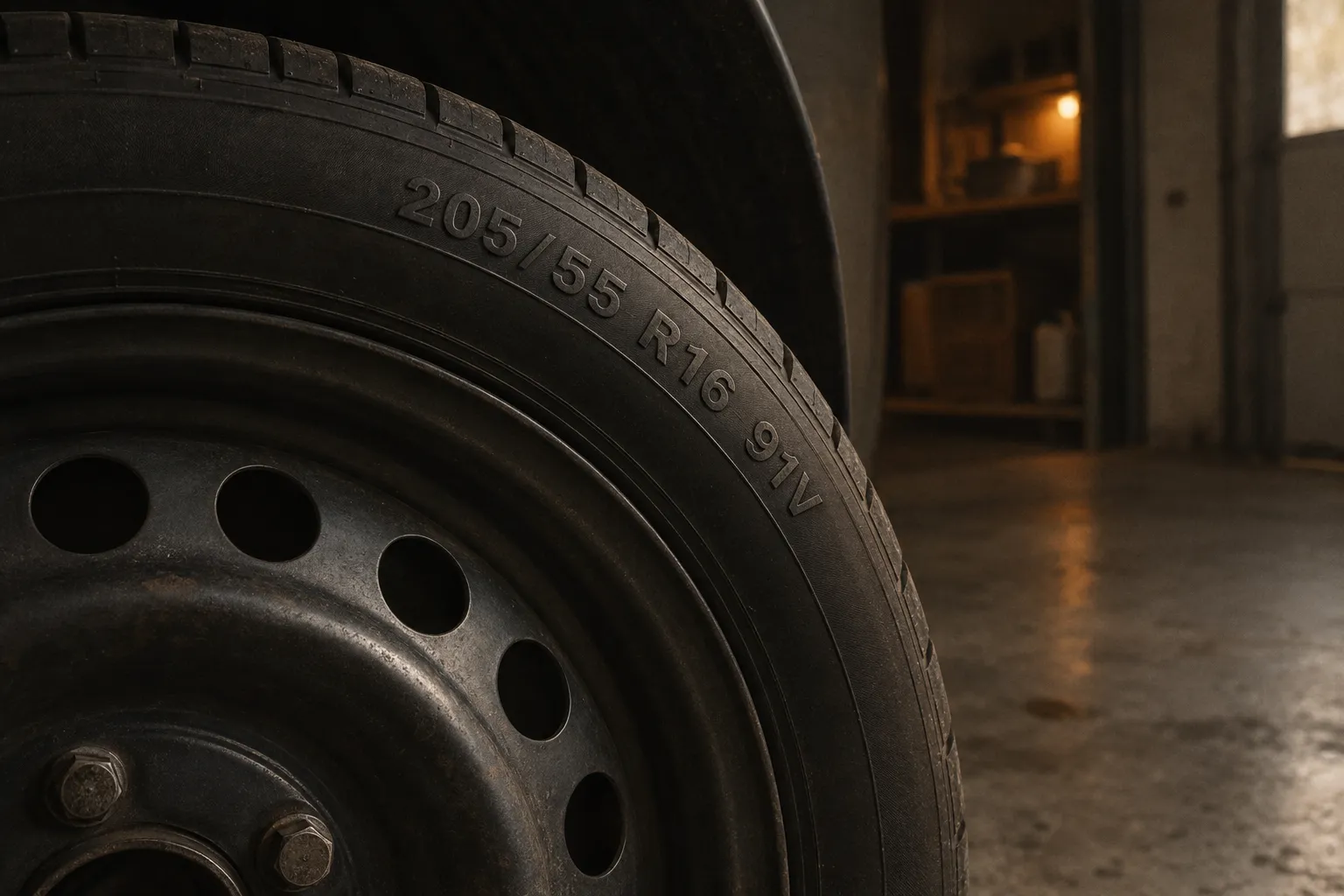
The marking isn't a code made up by each tyre maker. It follows an international rule for car tyres, UN Regulation No. 30, which says what each part means and the order it goes in. The size comes first. Straight after it comes what the rule calls the service description: the load index and the speed symbol, the "91V" on the end.

Know your tyre sizes by heart? Their own car can go on the wall too: one photograph, repainted in a style you pick.
From £19.99 · Poster
Reading 205/55 R16 91V, part by part
| Part | What it tells you |
|---|---|
| 205 | The width of the tyre, wall to wall, in millimetres |
| 55 | The aspect ratio: how tall the sidewall is, as a percentage of the width |
| R | The construction: R means radial |
| 16 | The size of wheel rim it fits, in inches |
| 91 | The load index: a code for the most weight the tyre can carry |
| V | The speed symbol: a code for the top speed the tyre can sustain |
The aspect ratio is the one people trip over. The sidewall is the band of rubber between the wheel and the tread, and 55 means it is 55% as tall as the tyre is wide. So a 205 tyre with a 55 sidewall has a sidewall 112.75 mm tall. The lower that number, the thinner the band of rubber you see round the wheel.
The rim number is a code, not millimetres. The regulation says to multiply it by 25.4 to get millimetres, and 25.4 mm is one inch under the Weights and Measures Act 1985, so in practice it is the wheel size in inches. Put the two together and a 205/55 R16 is 631.9 mm across. The tyre size calculator does that sum for any size, and shows what a change of size does to your speedometer.
The load index and the speed symbol
Neither of these is a measurement you can read straight off. Each is a short code that you look up in a table printed in the regulation. In the example, 91 stands for 615 kg, the most weight that one tyre is rated to carry. V stands for 240 km/h, which is about 149 mph.
| Speed symbol | Top speed (km/h) |
|---|---|
| S | 180 |
| T | 190 |
| H | 210 |
| V | 240 |
| W | 270 |
| Y | 300 |
The letters don't run in alphabetical order at the top end: H sits between U and V in the regulation's table. On some fast radial tyres you will see ZR in place of R, which the rule allows on tyres rated W or Y. All of these figures come from the regulation itself.
Older tyres and classic cars
Older sizes are often written without an aspect ratio, like 185R14. The MOT inspection manual says a "standard" car tyre has an aspect ratio of 82% unless marked otherwise, and that a 185/75R14 may be marked 185R14 as well. The same manual says radial and cross-ply tyres must not be mixed on the same axle. A cross-ply, which the regulation calls diagonal or bias-ply, has either no letter before the rim size or a D, so it is worth reading both tyres on an axle before you swap one.
Elsewhere on the sidewall is a four-digit date: the first two digits are the week and the last two the year it was made. Tyres made before 2000 may show just three digits. The tyre date code checker turns those digits into a date and an age, which is useful on a car that has stood for years with plenty of tread left.

For whoever does their own tyre checks: a classic up on the lift, tools on the wall and dust in the golden light.
From £96.99 · Framed poster
Written by Craig Fearn, Petrol & Ink. Last updated .