Power, in engineering, is the rate at which work gets done, not the amount of force involved. Horsepower is one of the units that rate can be quoted in. Georgia State University's HyperPhysics reference puts the definition plainly: "A horsepower is equal to 550 ft lb/s". In watts, NIST gives that horsepower as 7.456 999 E+02, so 745.7 watts to one decimal. That is all the unit is. Everything else about it is bookkeeping.
Know the figures on your own car? Send one photograph and see it repainted, free, before you decide.
From £19.99 · Poster
The bookkeeping is where the confusion starts. The same engine can appear with more than one power figure attached, because the number depends on where in the drivetrain it was measured and under what conditions. BHP is one such answer to "measured where", which is why it is a narrower term than plain horsepower, not a different thing.
Power also isn't the same measurement as torque, though the two are quoted side by side on every spec sheet and are related through engine speed. If the difference is the argument you keep having, torque against horsepower takes it apart properly.
Horsepower, PS and kilowatts side by side
| Unit | What it is | In watts |
|---|---|---|
| Horsepower (hp) | 550 foot-pounds per second, the imperial unit | 745.7 |
| Metric horsepower (PS) | The unit European makers often quote, from the German Pferdestärke | 735.5 |
| Kilowatt (kW) | The SI unit, used on UK registration documents and most new spec sheets | 1,000 |
The watt figures come from NIST's conversion tables. Because a PS is a little smaller than a horsepower, the same engine reads about 1.4% higher in PS than in hp: 150 hp is about 152 PS, and about 112 kW. When two spec sheets disagree by a few horsepower, check the unit before you check the engine.
Where the unit came from
The horsepower was James Watt's way of selling steam engines in the late 1700s. His customers already used horses to drive mills and pumps, so a figure telling them how many horses an engine replaced was something they could understand straight away. He settled on 33,000 foot-pounds a minute, which is the same as the 550 foot-pounds a second above. The unit has outlived the horses by a long way.
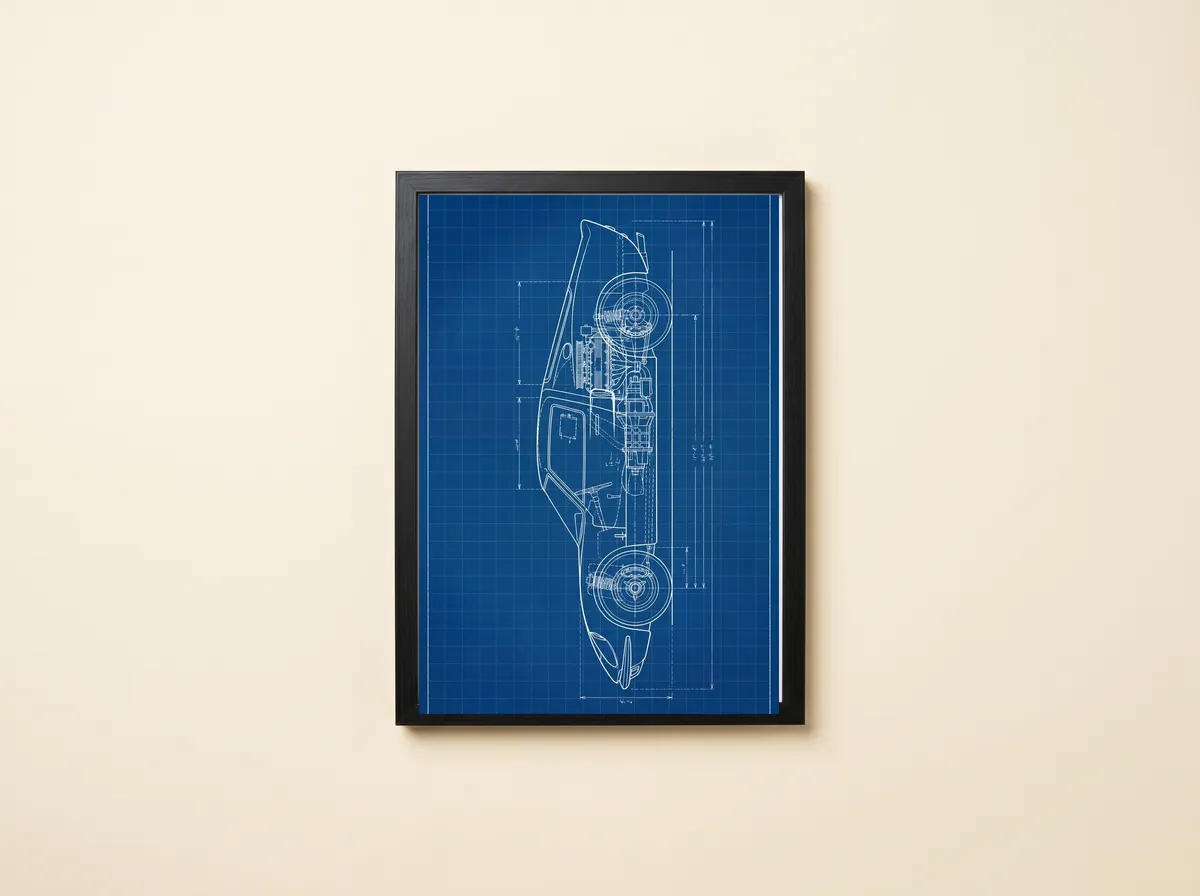
For the person who reads the spec sheet first: a cutaway of a rear-engined coupe, every part drawn in fine white line on blueprint blue.
From £96.99 · Framed poster
Written by Craig Fearn, Petrol & Ink. Last updated .