Operator's manual — original car art
Petrol & Ink

Racing posters, drawn rather than licensed.

Five pictures about the parts of motor racing that actually stay with people: the light, the dust, the noise you can almost hear, and the hour before anyone starts. None of them is a photograph, and none of them borrows a badge, a livery or a number from a real car.

Explore Apex at Dawn: formats & prices ↗
Apex at Dawn
From this collectionApex at Dawn
Jump to a section · 3 sections

The short version. Racing photography is owned by the people who were standing at the fence with a press pass, which is why most racing wall art is either a licensed print or a rephotographed archive poster with a licence fee inside the price. These five were drawn instead, so they cost what a print costs and they show a moment rather than a marque.

What each one is actually of

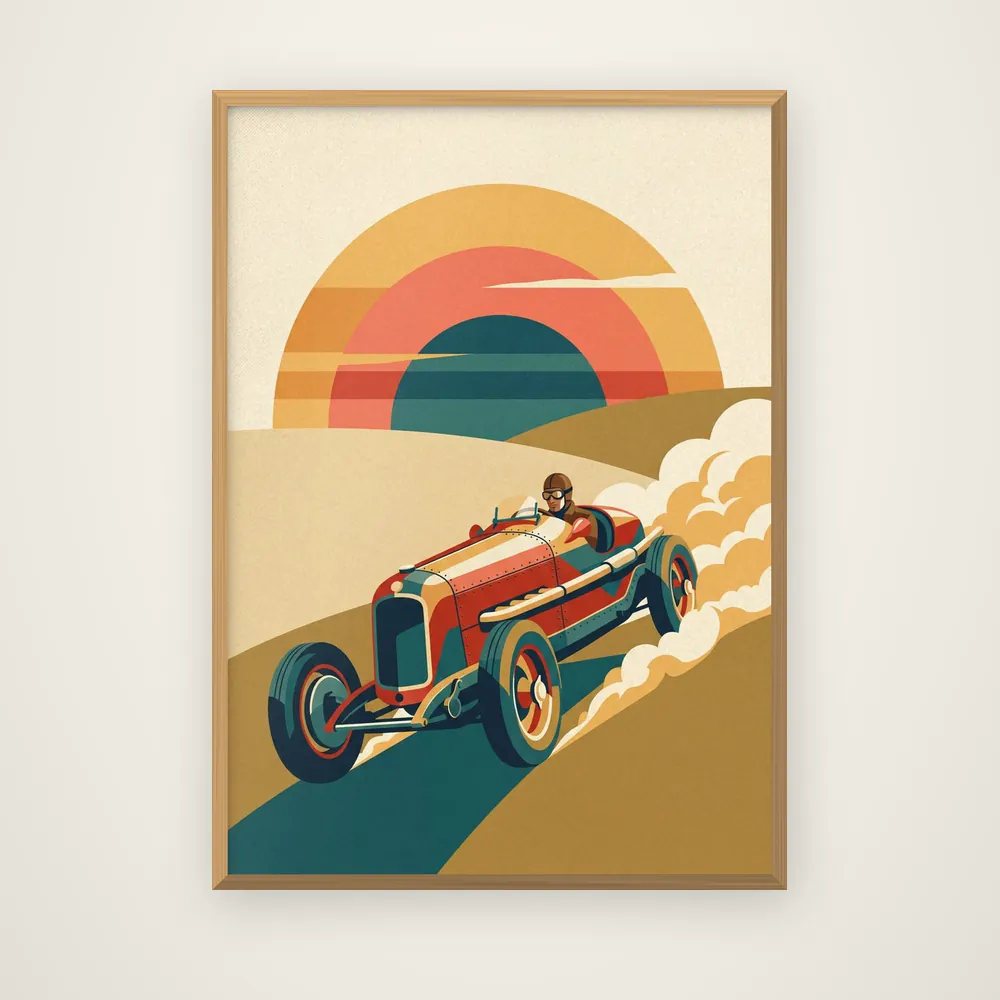
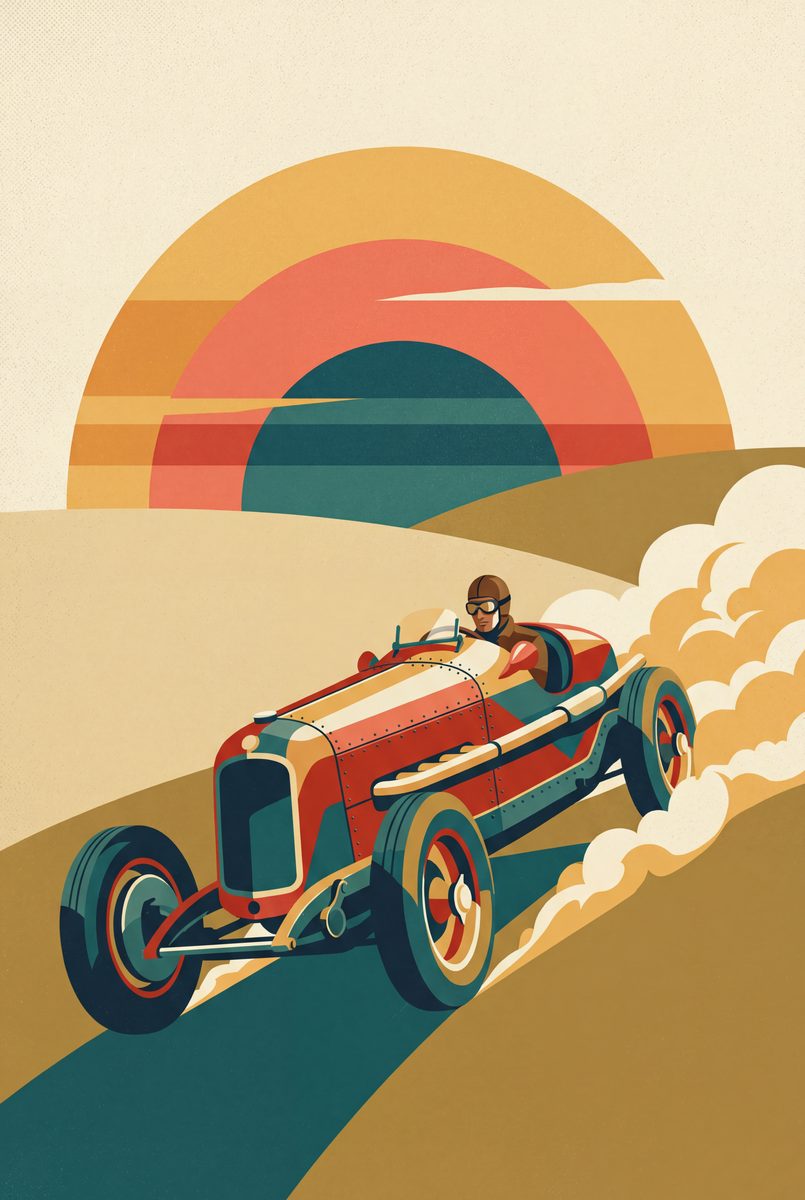
Apex at Dawn is a 1930s open-wheel racer cresting a hill into the sunrise with dust coming off the back of it. It's the earliest kind of racing there is, before aerodynamics were a discipline, when the car was a chassis with an engine in the front and a person sitting on top of it. Ochre, cream and a signal red, and it hangs warm.

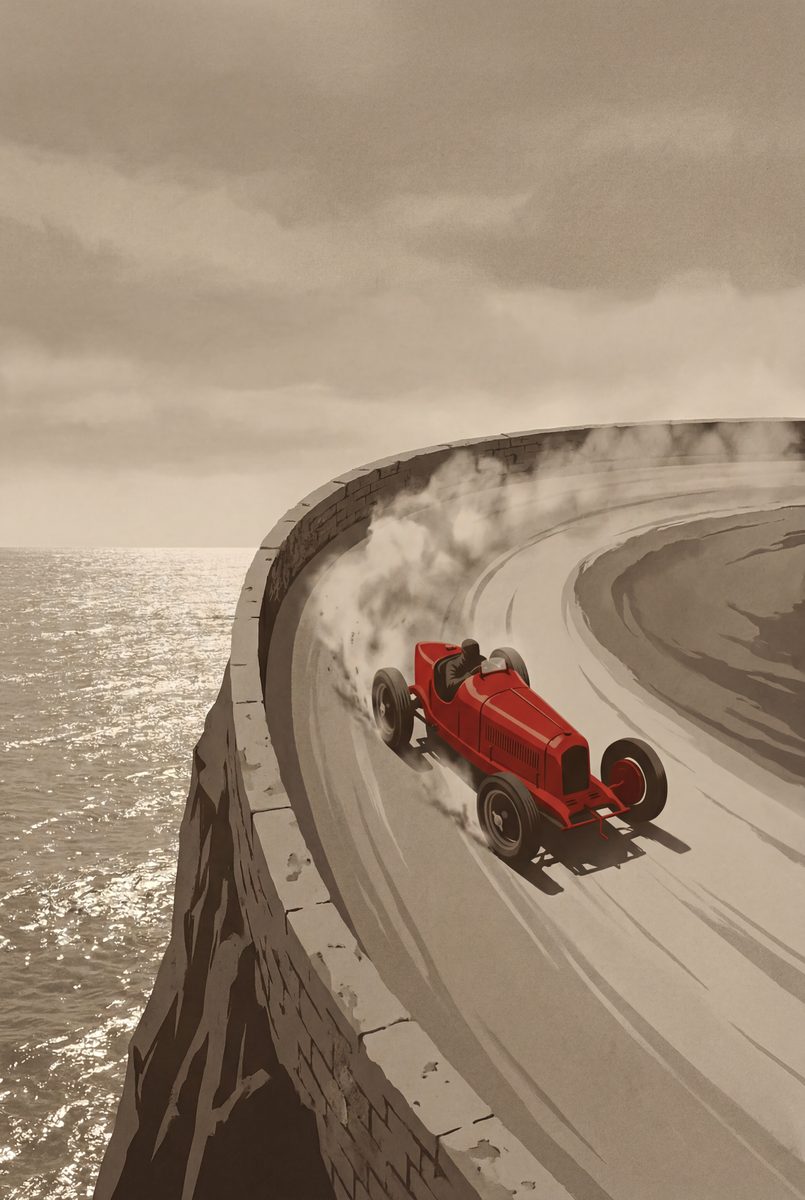
The Hairpin is the same era caught mid-corner: tail wide, dust flying, a cliffside bend above the sea. It's the picture for anyone whose interest in racing is really an interest in car control, because the whole composition is about a driver holding something that has already let go.

Endurance moves forward thirty years and turns the lights on. A 1960s prototype settling into dusk on the long straight, twin headlamps lit, hours still to run. Endurance racing is the discipline where the interesting hours happen after dark and finishing at all is an achievement, and this is the moment that becomes obvious.

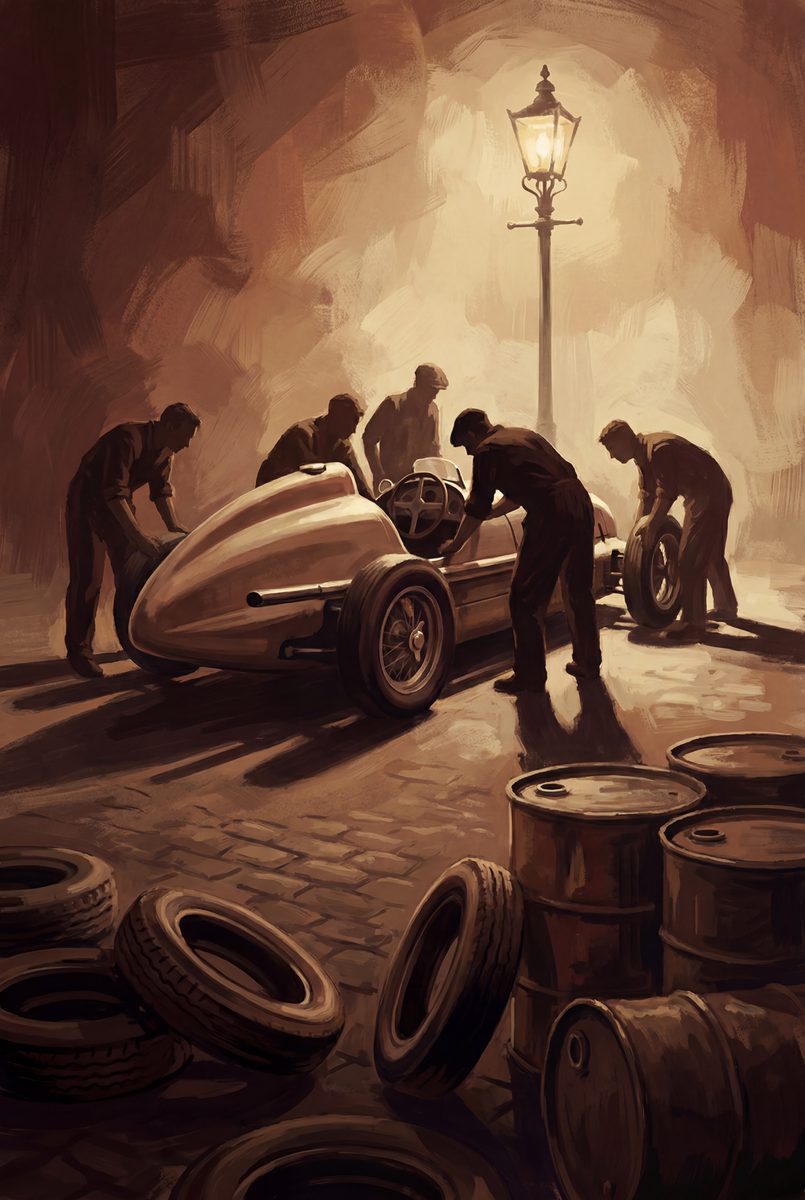
Pit Lane, 1955 is not about a car at all. Mechanics swarming a stripped racer under warm lamplight, oil cans, stacked tyres, everyone doing something. It is the argument that racing is a trade before it is a spectacle, and it is the one to give somebody who has ever rebuilt anything.

Aerodynamica is the wind tunnel: cyan streamlines flowing over a wedge-era silhouette, the shape of the air made visible. It reads as a technical drawing from across a room and as a piece of design up close, which is why it is the one that ends up in offices.

Why nothing here has a number on it

Every machine on this page is an original design. There are no manufacturer badges, no team liveries, no race numbers and no driver likenesses, because we don't hold a licence for any of those and we aren't interested in the version of this where a licensing department takes a cut. What is left is the thing that made the sport worth watching in the first place, which turns out to be enough.

If the specific championship is the point rather than the racing, the grand prix page explains what can and cannot honestly be sold. If the era matters more than the sport, the vintage posters cover the same decades away from the circuit.

Living with them

These four horizontal pieces sit well as a pair or a run rather than alone, and they take a black frame better than a light one because there is a lot of dark in them already. The wall is the stage that deals with that properly, size by size and frame by frame.

Pick the picture.

Open an artwork to compare its available formats, sizes and prices.

Questions, answered.

Are these prints of real racing cars?
No. Every machine on this page is an original design drawn in the spirit of its era. There are no manufacturer badges, team liveries, race numbers or driver likenesses on any of them.
What is the difference between these and the vintage car posters?
These five are about racing: the corner, the dusk stint, the pit lane. The vintage posters cover the same decades away from a circuit, so roads, harbours and workshops rather than competition.
Which one suits a garage or a workshop?
Pit Lane, 1955. It is the only one on the page about the people working on the car rather than the car itself, and it reads properly on a breeze-block wall.
Can I have a racing print of my own car?
Yes, through the Paint Shop. Upload a photograph and choose the vintage racing poster style, and your own car is repainted in that language. Nothing is charged until you have seen it.

Next

Grand prix art, and the licence question →

A print of a real car in a real season's colours is licensed merchandise: the marks and the liveries belong to the people who own them, and a licence fee sits inside the price. We do not hold a licence, so this page is honest about what is here instead.

Try it

Upload a photograph of your car, pick one of nine styles, and review the result before ordering. Three free previews a day, verified email and no card.

Try it on your own car

Or the photograph itself, printed as it is